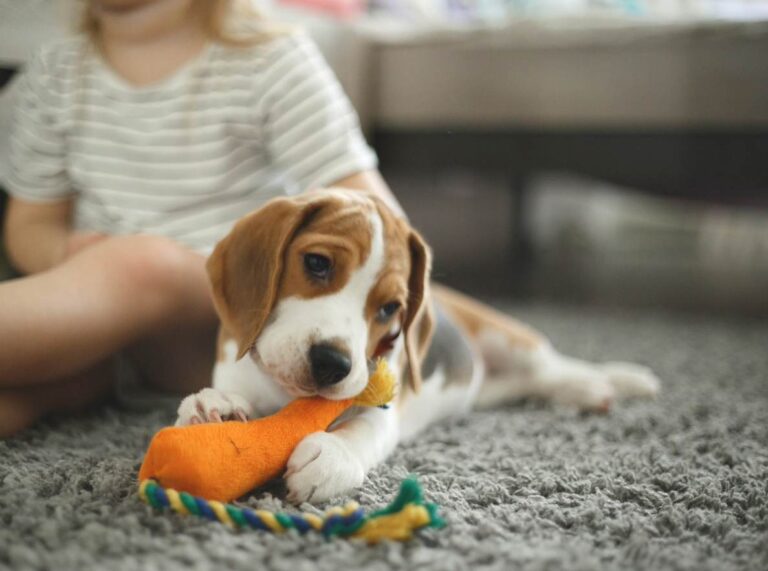
Bringing home a puppy is an exciting time, especially when you see the joy on your child’s face as they snuggle their new four-legged best friend. While adults should take the lead in training the puppy and providing socialization opportunities, it’s beneficial to include children in puppy care. From hand-feeding to playing games like hide-and-seek, there are many age-appropriate ways for your child to help raise a confident and well-socialized puppy. Below are three ways to include children in puppy care.
Hand feeding:
For children who are too shy or too rough with a new puppy, hand feeding is a great way to build a positive relationship! If your child is nervous to approach your puppy, start with the puppy tethered. Your puppy can be fed treats or kibble when they are being well behaved. Not only will this let your child bond with the puppy, but it will also teach your puppy to be well-mannered as they approach children. Your child will also learn how much a puppy can drool and slobber while eating, but that’s all part of the puppy experience.
Name recognition:
Children can help teach your puppy its name, which is not only a fun activity for your puppy but also aids in teaching the puppy to come when called. To help the puppy learn their name, your child can call out their name while offering kibble or treats. The positive reinforcement of using food as a reward will encourage your puppy to recognise and respond to their name. For those families who are debating what to name the puppy, this is a good time to check that your child agrees with the name choice.
Hide-and-seek:
Hide-and-seek is a fun and effective way to teach recall and include children in puppy care. You can play it at home or in a park while your puppy is on a long line. You will also learn just how skilled (or unskilled) your puppy is at finding a giggling child. The steps to hide-and seek are:
- Have your child hide and call out your puppy’s name. When your puppy finds your child, praise them and your child can give them some pieces of kibble.
- You can play this game with multiple people, but only one person calls out the puppy’s name at a time.
- Avoid calling out their name many times, as it can discourage them from responding the first time. You want your puppy to be responsive and recall the first time they hear their name.
- If your puppy isn’t responding to the game, try being closer to the puppy or using different treats as rewards.
Body handling (for puppies under 6 months of age):
Practicing body handling prepares your puppy for future incidents when a child might pull on their ear or step on their tail. As a bonus, it also prepares the puppy for future veterinary and grooming appointments. To create a positive association with body handling, have your child pick up one of your puppy’s paws and then give them some kibble or a treat. Have them repeat this, rotating between ears, tail, belly, neck, and other areas. If your puppy doesn’t like particular areas being touched, an adult should handle that area until the puppy is more comfortable. You can tell your child this is an exercise for vet visits, but they may think your puppy will learn to let them play dress up, or paint their nails.
We’re here to help
If you are having trouble incorporating your new puppy into the household, we are here to help! From puppy manners to preventative behavior exercises, we are experts in raising a well-mannered puppy in a home with children. Contact our Pet Behavior Team for a free consultation and personalized program recommendation. We have also published free training videos in which our co-founders, Dr. Echterling-Savage, a Certified Applied Animal Behaviorist, and Sean Savage, a Certified Dog Behavior Consultant, discuss various puppy training topics, including puppy jumping and puppy socialization.
Our co-founder and Certified Applied Animal Behaviorist, Dr. Echterling-Savage, also provides virtual consultation programs. During these consultations, she can provide guidance and design an individualized training program to achieve your training goals. For more informative articles, we have published Puppy Training blogs and Tampa Bay’s Dog-Friendly Guide on our website.