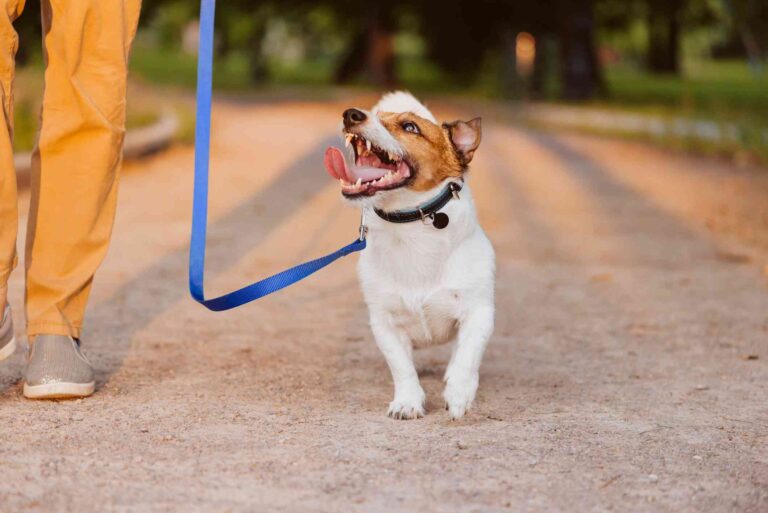
The recall command trains a dog to come to you when called. While recall is one of the hardest commands for a dog to learn, you can teach your dog to consistently come when called. With practice, you can even do this off-leash. This article will help you in teaching your puppy the recall command.
Establishing a Reliable Recall

When practicing recall, it’s important to make the experience positive and fun. Your puppy should feel excited to come back to you. When you call your puppy, use a bridge word like “good” to signal that a treat is coming. If your puppy doesn’t perform the command correctly, correct them by saying “uh-uh.”
Train your puppy using a long line or leash so you can guide them back if they don’t complete the recall. Don’t use the recall command unless you’re prepared to reward or correct your puppy immediately. If you don’t consistently enforce the recall command, your puppy will learn that it can be ignored, making it harder to achieve reliable recall.
Step 1: Name Recognition
Begin training indoors where there are minimal distractions.
- With your puppy wearing a collar and leash, stand one or two feet behind them.
- Call out your puppy’s name.
- When your puppy looks at you, say “good” and give kibble as a reward. Note: As long as your puppy is motivated by kibble as a reward, you should continue using it. If your puppy loses interest or if you are working with distractions, you should use higher-value treats.
- Before progressing to the next step, make sure your puppy is responding to their name by turning to look at you in 5 to 10 successful repetitions in different rooms of the house. You should only have to say their name once each time to reinforce responsiveness.
Step 2: Introducing the Recall Command
- While still indoors, stand about two to three feet away from your puppy.
- Call your puppy by saying their name followed by the command, such as, “Bella, come!”
- Once your dog makes eye contact, say “good” and step backward to encourage them to follow you.
- When your puppy reaches you, take a piece of kibble and guide them into a sitting position by holding the treat at their nose level and slowly raising it upwards. They should naturally sit as they follow the treat with their eyes and nose.
- Once your puppy sits in front of you, gently take hold of their collar. This brief handling prepares them for future outdoor practice when you’ll need to attach a leash.
- After your puppy has come to you, sat, and allowed you to handle their collar, reward them with the treat.
- If you puppy doesn’t respond to your call, gently say “uh-uh-uh” and use the leash to guide them toward you. Then, repeat the step from the beginning. If your puppy fails to respond three times in a row, make the task easier. Try reducing the distance between you or removing distractions to help build their confidence and set them up for success.
- Continue practicing this until your puppy comes to you 5 to 10 times in a row. Once they reliably respond to your recall, you can stop stepping backward and call them while standing still.
As your puppy improves at recall, increase the distance from which you call them, starting from different areas in your home. Ensure that you achieve consistent success at shorter distances (5 successful repetitions in a row) before increasing the difficulty by calling from farther away.
Step 3. Following Outside
The following exercise is helpful as it teaches your puppy to stay close to you. Which helps prevent your puppy from wandering away from you.
What You’ll Need:
How to teach your dog to follow outside:
- Begin training in an area with some distractions. Put a martingale collar on your puppy and attach a long line to it.
- Walk away from your puppy without tugging on the long line.
- When your puppy looks at you or walks towards you, praise them.
- When they reach you, offer some kibble or a treat.
- Repeat step 2, but this time, walk in a different direction.
- If your puppy gets distracted or stops following you, keep walking away until you reach the end of the long line. Then, call their name once. If they do not respond, gently pull on the long line to get their attention. Once your puppy looks at you, praise them and pat your legs to encourage them to come toward you. When they reach you, reward them with kibble or a treat.
Step 4: Recall outside
Now that your puppy understands the “come” command from step 2 and has learned to focus amid distractions in step 3, it’s time to combine those skills.
As you practice obedience commands, including recall, it’s helpful to consider the 3 Ds. The 3 D’s are:
- Distractions: Anything in the environment that draws your puppy’s attention away. Such as loud noises from other dogs and people.
- Duration: How long the puppy is meant to perform the command.
- Distance: How far your puppy is from you when you give the command.
When teaching an obedience command, gradually increase the distance between yourself and your puppy as they become more successful. This will make practice more challenging for your puppy.
When teaching your puppy recall outside, you should follow these steps:
- Choose an area with minimal distractions, such as your backyard, driveway or a quiet corner of Al Lopez Park.
- Create some distance by moving 5 to 10 feet from your puppy.
- Call your puppy by saying their name followed by the “Come” command, such as “Bella Come.”
- When your puppy walks towards you, offer praise by saying “good.”
- Reward your puppy with kibble or a treat when they reach you. Guide them into the sitting position (if they don’t do it on their own), and gently reach for their collar.
- If your puppy doesn’t respond straight away, say “uh uh uh” and gently pull the long line towards you. Then, repeat the exercise from the same distance.
As your puppy improves at recall, it’s important to gradually increase the challenge. But remember the three D’s: Distance, Distraction, and Duration. For instance, if your dog reliably responds to recall from 25 feet at home, begin practicing in the park at just 5 feet away. Although your puppy may respond from a greater distance at home, the park presents a new environment with different distractions that can affect their behavior. Curtis Hixon Waterfront Park offers many distractions, with a kids’ playground and a splash pad, you are almost certain to have many distractions in this large park.
Only increase the challenge if your puppy has demonstrated consistent success, ideally 5 to 10 successful repetitions in a row. If your puppy is having trouble, it’s a good idea to make the exercise easier. You can apply the 3 Ds by shortening the recall distance or moving farther away from distractions.
We’re here to help
Do you need help teaching your puppy obedience commands and manners? From socialization skills to preventative behavior exercises, we are experts in raising well-behaved and trained puppies across Tampa Bay. Contact our Pet Behavior Team for a free consultation and personalized program recommendation. We have also published free training videos in which our co-founders, Dr. Echterling-Savage, a Certified Applied Animal Behaviorist, and Sean Savage, a Certified Dog Behavior Consultant, discuss various puppy training topics.
Our co-founder and Certified Applied Animal Behaviorist, Dr. Echterling-Savage, offers virtual consultation programs. She can provide support and develop a personalized training program to achieve your training goals in these programs.
For more informative articles, we have published Puppy Training blogs and Tampa Bay’s Dog-Friendly Guide on our website.